A mass M is suspended from a spring of negligible mass. The spring is pulled a little and then released so that the mass executes simple harmonic oscillations with a time period T. If the mass is increased by m then the time period becomes  . The ratio of
  is
is
Text Solution
Verified by ExpertsThe correct answer is:
A
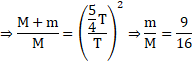
 ⇒ ⇒
⇒ ⇒  ⇒ ⇒
⇒ ⇒ 
Prepare Smarter with CGP Edu
Get practice questions, solutions, and test series in one place.
Write a Review
Share your experience with this question and solution.
Commentary
Send your comment, doubt, correction, or feedback to admin.
Similar Questions
Explore conceptually related problems
Two bodies M and N of equal masses are suspended from two separate massless springs of force consta…
A mass m is suspended by means of two coiled spring which have the same length in unstretched condi…
Two masses and are suspended together by a massless spring of constant k. When the masses are in …
In arrangement given in figure, if the block of mass m is displaced, the frequency is given by
A mass is suspended from the two coupled springs connected in series. The force constant for sprin…
A spring is stretched by 0.20 m, when a mass of 0.50 kg is suspended. When a mass of 0.25 kg is sus…